With the social media explosion of the past year, everyone's getting in on the Black Friday action. #BlackFriday has been a trending topic on Twitter for about a week, and scores of people are asking around the social media grapevine which retail outlets have what deals for the famed day of savings.
Gowalla, Facebook Places, and other social media giants have artfully begun their marketing for the shopping season. Partnering with businesses like American Eagle and Radio Shack, they advertise extra savings just for checking in while you shop. Target is a retailer that (wisely) invested in promoted tweets for Black Friday, guaranteeing their name stays atop the competition in your Twitter feed.
What do you think? Is this all just hype, or are you excited by the idea of savings just for hitting a button on your smartphone?
Check out a great article about social media and Black Friday at Mashable, plus a list of participating businesses and their offered deals.
REJECTED: How Google Places Gets Aggressive
In June of 2010, Google Places amped up its algorithm by introducing a much more aggressive listing level spam review process. What does this mean, exactly? Well, as it often does in the world of SEO, it means the rules have changed again. While your Google Places listing may have once been at the top, it can be buried by just tweaking your post a little -- or sometimes, for seemingly no reason at all.
This includes certain touchy rules such as not using the word "google" in a Places entry, allowing only up to 3 capital letters together (such as LLC or LTD), and various sexual words being banned from all listings.
In other words, Google Places means business.
If you'd like to read on and see what else these aggressive new changes entail and how to properly utilize them, see the original article here.
In other words, Google Places means business.
If you'd like to read on and see what else these aggressive new changes entail and how to properly utilize them, see the original article here.
Twitter VS Facebook: Who's Winning the Click-Through Contest?
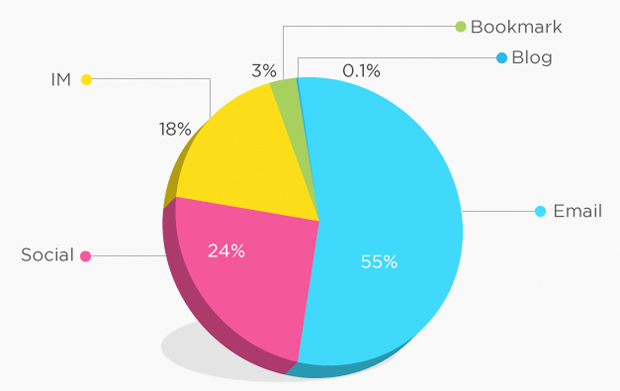
According to this article from Fast Company, Internet sharing trends have shifted dramatically. While email still remains king with 55% of referrals, social networking sites saw a 10% jump. But out of that arena, who's winning? And how reliable is the source?
Simply put, Facebook is overwhelmingly the favorite for social network of choice with 78% of the market share. Twitter only accounts for 5%. Yet, the stats appear to lean towards Twitter rather than Facebook -- links shared through Facebook have a click-through rate of 287%, while Twitter boasts an astounding click-through rate of 1904%.
But what does this mean?
If the click-through rate is so high on Twitter, but it's not the social network of choice, how many clicks are really valuable? And what about spambots or spyders checking these links -- does that have an effect on the rates? And some savvy commenters argue that yes, the Twitter click-through rates will be inherently higher because that's all Twitter is. Facebook has more content than just links, therefore the rates are lower.
What do you think? Is there a simple answer for these statistics, or are the waters too muddied with other complications?
You can read the whole article and see the in-depth stats here.
Simply put, Facebook is overwhelmingly the favorite for social network of choice with 78% of the market share. Twitter only accounts for 5%. Yet, the stats appear to lean towards Twitter rather than Facebook -- links shared through Facebook have a click-through rate of 287%, while Twitter boasts an astounding click-through rate of 1904%.
But what does this mean?
If the click-through rate is so high on Twitter, but it's not the social network of choice, how many clicks are really valuable? And what about spambots or spyders checking these links -- does that have an effect on the rates? And some savvy commenters argue that yes, the Twitter click-through rates will be inherently higher because that's all Twitter is. Facebook has more content than just links, therefore the rates are lower.
What do you think? Is there a simple answer for these statistics, or are the waters too muddied with other complications?
You can read the whole article and see the in-depth stats here.
Oops: New Gap Logo A Design Disaster
Due to steadily declining sales, clothing store The Gap decided to rebrand. Put some new life in its veins. Well... let's just say, they missed the mark.
The world has had all week to chew on the new logo since its release on Monday, and so far, most have spit it back out. No one is quite sure what the new logo is trying to accomplish -- you can't exactly praise its simplicity, since the tried-and-true old version was a sparkling example of clean lines and space. The square means... something, but what that is remains unclear. The stark use of Helvetica is drawing many comparisons to a competitor's brand, American Apparel.
After their new branding efforts failed to capture the hearts of millions, Gap has switched tactics -- and is now launching a crowd-sourcing effort. Meaning? "Design our logo for us, if you hate the new one so much!"
Last resort, or genius viral marketing? It could be that this whole fiasco was actually planned from the beginning, designed to generate buzz and then reap the benefits of a practically free new logo. I'll admit one thing -- it's the first time I've even thought about Gap in years, much less had a conversation about them.
Read the whole story here, as well as an apology explanation from Gap's president Marka Hansen.
Sorry, Guys: There Is No Marketing Silver Bullet
As an agency (and you as a business owner or manager), we are constantly hit with a barrage of the newest, best, latest and greatest ideas to hit the advertising marketplace. While there is probably a place for most of these ideas in someone's marketing plan, there is absolutely not one singular item that will solve all of your marketing woes. Despite what you might hear, there is no silver bullet. I'm sorry. If there were, we'd give it to you, and be happy to do so!
Here's the thing, guys... integration is the only thing that works for all your needs. Facebook and Twitter should never be your entire marketing effort. Their reach is just too limited, and there is no genuine proof that either will help improve your ROI. When handled correctly, and within a larger plan, they can work for you. But if you are reaching out to consumers, you might still need some mass medium to tell people that you are on the blogosphere, and where they can find you.
Likewise, you can't build a great website and hope people think about looking for you...you have to tell them it's out there and where to go look for it. And as much as we love email marketing, without a decent website and a comprehensive branding approach to support it, sending just another boring email into the stratosphere will wind up killing your credibility. Oh, and if your TV and radio ads aren't working like they used to, it's most likely because you either don't have a website or the one you have is ruining your reputation...and your lack of an SEO plan is probably sending people to your competition's websites because they are on page one of Google and you're on page 3.
In short, you can't rely on only one approach to your marketing. You must integrate across as many channels as is feasible within your budget. If you'd like to hear more about integration, join us for our upcoming seminars in Joplin and Pittsburg in October.
Or, if you'd like to meet with us to discuss your marketing plan and integration strategies, give Ron a call at 417-889-1658x102 or email him ron@redcrowmarketing.com.
Target Practice: Who & Where Are Your Customers?
Here is everybody. Young, old, rich, poor, married, single, you name it. Everybody is here.
No matter if you have tight targets or multi-segment targets, you should try to know them and define them as closely as you can. You need to target “who it is” that you are trying to reach with your advertising.
Any given product or service does not appeal or apply to everybody equally. So why advertise to those people who will not ever use your product or service? That would be a waste of advertising money, right? Small businesses do it all the time.
One of the most costly and overlooked planning staging is determining who you should be targeting as customers. Too often this is not done very well, creating a “shotgun” blast of advertising that generates a lot of expense and little return. Advertising to “everybody” is very, very expensive.
The idea here is to isolate your most profitable or best potential slice of the “everybody pie” and focus your advertising dollars on them. Gaining market share in these groups whether their defined by demographics, psychographics or geographical boundaries will increase the odds your advertising will pay for itself. Often you will still gain exposure to secondary target segments - but target the bigger returns first.
To reach qualified prospects with your advertising, you’ve got to have a clear idea of who they are. This will help you select the right media, create the right message, as well as improving your closing ratio.
Tight Targets
Sometimes your target audience will be very “tight” or a specific segment of the public. You may be trying to reach only nurses, or men who like to hunt deer, or retirees needing electric wheelchairs. These simple characteristics make our target easier to reach with advertising. Most of these groups have specialized magazines, publications, websites just for them. Some of the even have specific cable shows they like to watch. It just takes a little research and common sense.
Often, our targets are a wide group of people with different characteristics and interests. For instance, an optometrist needs to promote himself to just about everybody: men and women, young and old. In this case, it would be difficult (if not impossible) to find simply one publication or television show that will reach them all. You might have to use a multi-media approach, and that will be more expensive than simply trying to reach only deer hunters.
Multi-Segment Targets
There is also the issue of more than one target for the same advertiser. Take for instance, Sears or Wal-Mart. They have items for just about everybody. Both of these chains run “image” advertising that is designed to a) create an impression and b) remind you about them. Again, advertising dedicated entirely to image is normally only for the privileged companies who have big financial resources. This is because it does not generate the immediate return and price and product advertising required by small businesses.
Although they spend a lot of money in image advertising, most of the advertising the big guys and gals do is targeted campaigns; using different media and different messages to target specific buyer segments within their wide and diverse audience. Sears will send a direct mail flyer to a database of men that might by Craftsman tools. At the same time, they may have a Fall Fashion Clearance advertisement running nationally on television shows with large numbers of women viewers. Here you have the same store trying to reach two different audiences, using different media with different creative approach in the ads.
Get Your House In Order: Fixing Bad Business Practices
Before you can hope for business improvement from your advertising, take a look around. Is your house in order? Is all this new business brought in by your marketing efforts going to be pleased with what they see? You can't hope to keep new customers if you haven't fixed the fundamental problems with your business.
Ideally, advertising effectiveness should be measured by the number of qualified prospects it delivers, not the sales volumes. Time after time I’ve sees advertising improve traffic flow for businesses who fail to convert the prospects into customers because of poor service, bad pricing, poor inventory, dirty store, and a variety of other reasons. The slow sales were not the fault of the advertising; the problem was with the business itself.
The point here is:
You have ONE chance to make a first impression. Stop and look at your business from the position of the prospect on a first visit. Is your appearance right? Is your staff knowledgeable? Is your product or service mix right? Before you spend a dime on advertising to get more prospects, make sure you’re ready for them!
For instance, I had one client who had a great advertising campaign that delivered qualified prospects. They then opened a new store in an old warehouse where the only entrance was in the back (in an area enclosed by chain link fencing.) I literally watched customers drive in and immediately drive back out because there were no signs telling them this is where they were supposed to come in. They thought they were in a delivery or contractor only area - so they left.
Worse still, another client was not seeing sales generated because their sales person was rude and unhelpful (when the boss wasn’t there). We had to send in secret shoppers to prove it to the client.
Good advertising does not fix a poorly run business.
Subscribe to:
Posts (Atom)
Labels
- advertising (9)
- agency (1)
- branding (4)
- budgets (2)
- business (5)
- CORE (1)
- design (1)
- direct marketing (6)
- email marketing (2)
- graphic design (1)
- logo (1)
- marketing (14)
- media (2)
- public relations (1)
- sales (1)
- sem (2)
- seo (2)
- social media (6)
- web design (1)